Distance Learning Research
- Jonahtan Rabago

- Dec 13, 2020
- 3 min read
Summary
The Covid-19 pandemic has forced students and teachers alike into this new online mode of education, which can have its bugs as in any other new process. For this project, I completed generative research to learn more about how distance learning has impacted student collaboration and connections—both synchronous and asynchronously—and find ways to improve upon these issues, for the next semester(s).
Kumari Pacheco and I were the only researchers.
Generative Research Experience
When finding interviewees for this research, we were looking for a diverse view of backgrounds. For example, gender, geographic location, and seniority in college. Since it was a quick week-long process of interviews, we were not really able to diversify the experience of majors.

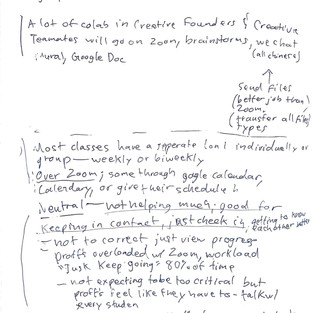
Interviews were around 20 minutes long; mostly through Zoom, except for one phone call. I found it really effective to take notes with pen and paper since it was the most efficient way for me to articulate all of my notes and link commonalities when note-taking in real-time. As the interviewee was talking, I would write quick notes with abbreviations and would group things together using lines and arrows.







Once the interviews were over, I would write down my notes on sticky notes using Mural. I would attempt to simplify my notes but still give the essential information; organize them by proximity grouping and outline the ones that stand out the most. We were prompted to interview no more than three people of every gender so once we had all the interviews we needed, we were ready to start organizing all of our notes.

.
Synthesis Process
Once we were done with interviewing and note-taking, we started synthesizing our process. First, we started clustering ideas with commonalities.

From this, we created an affinity map for these notes by labeling and filtering these clusters in a more sensible manner.
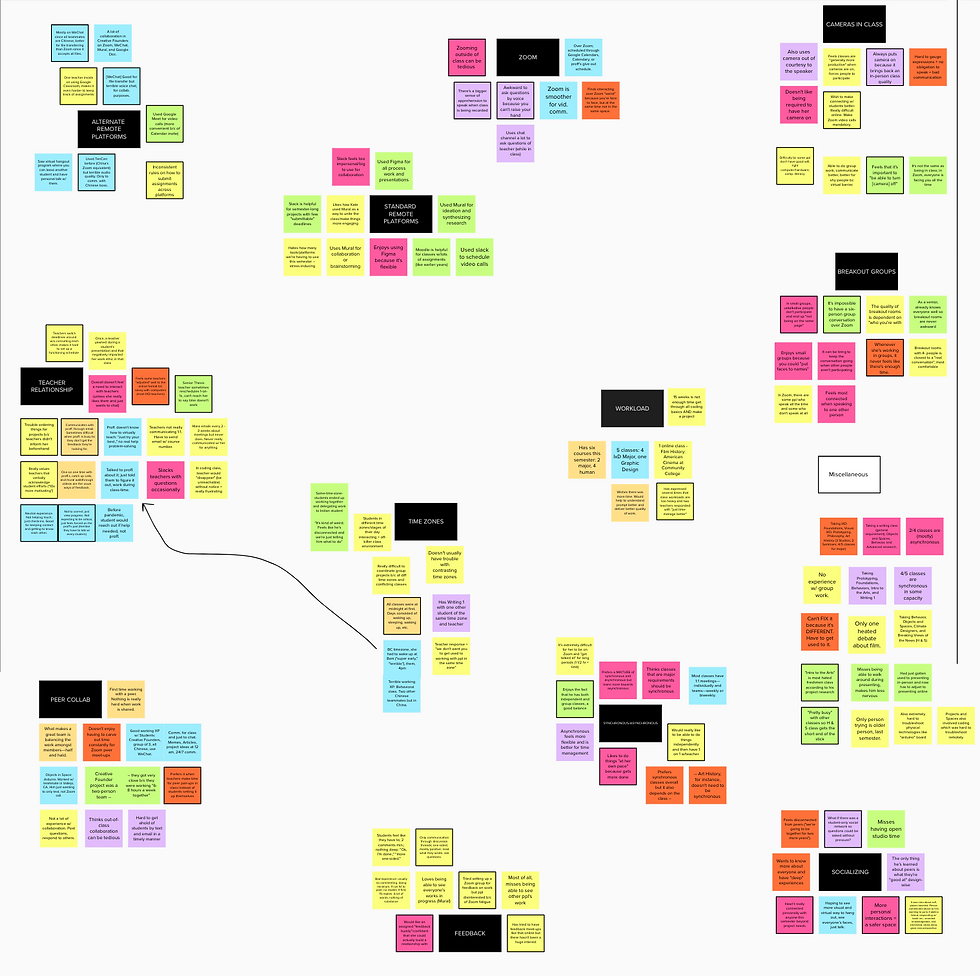
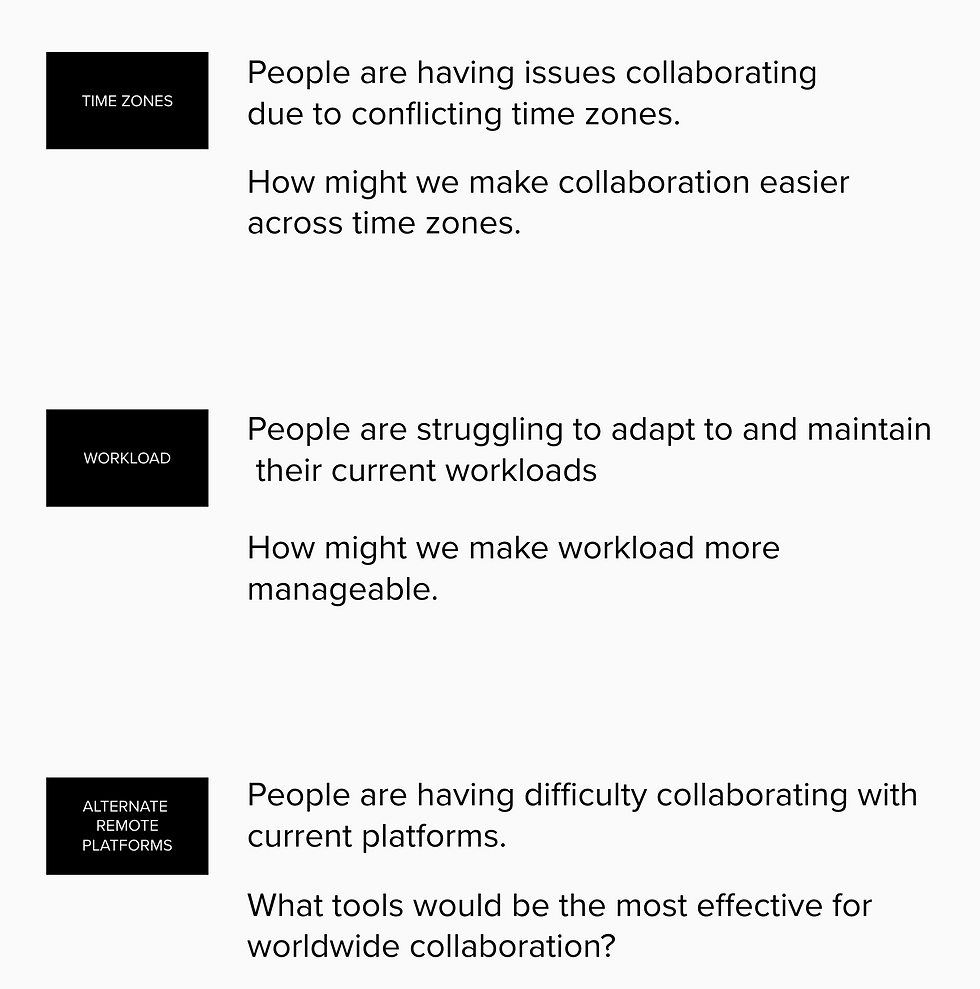
After, selected our top three issues that could be worked on for the upcoming semesters: time zones, workload, and alternate remote platforms. We chose these issues because they would not have to change the mentality of individuals, they were not subjective or divisive, and by fixing these issues, the rest of the problems would be solved.
We then organized these issues by a hierarchy of importance. Time zones seemed to be the most important since there is a large percentage of international students that seemed to be affected by their class schedules and national students included, with collaboration. The workload was second in importance because from what we noticed, a lot of the difficulties from our research stemmed from the number of assignments, managing time, collaboration, and lack of help. Lastly, alternate remote platforms were significant because it seemed like there was too much software to learn and use just to collaborate, manage their classes and assignments.
Finally, we stated the troubles people were having with the issue and formed it into a question which we would use to solve the problems.
Reflection
Through this online learning research assignment, I gathered a lot of valuable skills that I could use in future projects. For example, I learned the importance of diversifying the people you will interview because it provides you a wider range of information, which can reflect onto the people being helped by your product. With that, I learned that questions should be more open-ended since you do not want to gear your interviewee in a direction, thus, receiving more honest results. Also, having them expand on an answer was really useful because it can also spark more information out of their memory and more detailed information altogether. I also learned effective note-taking skills while interviewing to capture simplified and effectual notes. Finally, I learned how to synthesize the notes I took and organize them in ways that help me distinguish the most relevant problems to work on with the data I acquired.
Comments